libauc.trainer
The trainer API provides a high-level training interface
for classification tasks, including YAML-driven training entry points,
callback-based loops, and dataset/model/loss/optimizer orchestration.
Training Pipeline
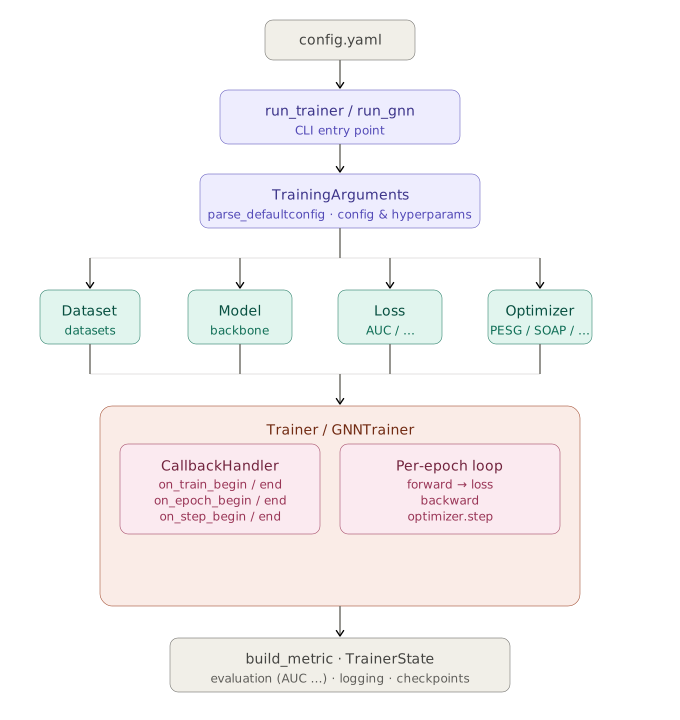
Module and Class Overview
Name |
Description |
|---|---|
|
Utility functions for building evaluation metrics |
|
CLI entry point for image / tabular classification tasks |
|
CLI entry point for graph neural network (GNN) tasks |
|
Callback system for hooking into training lifecycle events |
Core training loop for image and tabular classification models |
|
Training loop for graph neural networks, extending |
|
Dataclass holding all resolved training hyperparameters |
|
YAML config parser and default-value resolver |
|
Dataset loaders and the |
libauc.trainer.helpers
libauc.trainer.run_image_trainer
Entry point for image / tabular classification training. It reads a YAML
config file, merges it with built-in defaults, builds all components
(dataset, metric function, TrainingArguments),
and hands off to Trainer.
python -m libauc.trainer.run_image_trainer --config_file config.yaml
Any TrainingArguments field can be overridden directly on the command line,
e.g. --epochs 50 --batch_size 64.
libauc.trainer.run_graph_trainer
Entry point for graph neural network (GNN) training. Mirrors
run_image_trainer but uses GraphTrainer
and a GNN-specific model config (emb_dim, num_layers, etc.).
python -m libauc.trainer.run_graph_trainer --config_file config.yaml
libauc.trainer.core.callbacks
- class CLICallback[source]
Console and Weights & Biases logging callback.
On
on_train_beginit initialises a W&B run (silently falls back to console-only when W&B is not installed) and pretty-prints the fullTrainingArgumentsconfig.On
on_epoch_endit:appends a structured entry to
state.train_log;renders a progress bar (
verbose=1) or a per-epoch line (verbose=2) to stdout;ships the flat log dict to W&B via
wandb.log.
On
on_train_endit prints a training summary (best validation and test scores) and callswandb.finish().Note
This callback takes no constructor arguments. All configuration is read from
TrainingArgumentsat runtime via theargsparameter passed to each lifecycle hook.Note
W&B logging is silently disabled when
wandbis not installed or whenwandb.lograises an exception.- on_epoch_begin(args: TrainingArguments, state: TrainerState, **kwargs)[source]
Apply learning-rate / regulariser decay if the epoch is scheduled.
Checks whether
state.epochis listed inargs.decay_epochs. If so, decays by a fixed factor of 10:
- on_epoch_end(args: TrainingArguments, state: TrainerState, **kwargs)[source]
Record metrics, update the console display, and log to W&B.
Appends a structured record
{metrics, epoch, lr, train_loss}tostate.train_logfor later retrieval (e.g. byon_train_end).Console output (controlled by
args.verbose):verbose=1— overwrites a single progress-bar line in place using\r, showing a block-character bar, loss, all eval metrics, and the current LR. A newline is printed only on the final epoch so the bar persists after training.verbose=2— prints one pipe-separated line per epoch (Epoch N/T | Loss: X | AUROC: Y | LR: Z).verbose=0— no console output.
W&B — ships the flat log dict to
wandb.log(no-op if W&B is unavailable).Increments
state.epoch.
- on_step_end(args: TrainingArguments, state: TrainerState, **kwargs)[source]
Increment the global step counter.
Increments
state.stepby 1 after every optimizer update, keeping a running total of training steps across all epochs.
- on_train_begin(args: TrainingArguments, state: TrainerState, **kwargs)[source]
Initialise W&B and print the training config.
Attempts to start a W&B run using
args.project_nameandargs.experiment_namewith the fullTrainingArgumentsdict as the run config. Ifwandbis not installed the run is silently skipped andself._use_wandbis set toFalseso all subsequent W&B calls are no-ops.When
args.verbose != 0, pretty-prints the resolved config between two====separator lines so the user can confirm all hyperparameters before training starts.
- on_train_end(args: TrainingArguments, state: TrainerState, **kwargs)[source]
Print a training summary and close the W&B run.
Prints a
"Training complete."separator whenverbose != 0.Calls
wandb.finish()to flush and close the W&B run.Scans
state.train_logto find the best epoch (highest value of the first metric on the first eval split) and reports:1 eval split — best validation score.
2+ eval splits — best validation score + average of all remaining test split scores at that epoch.
Stores the summary dict under
state.train_summary.
- class TrainerCallback[source]
Base class for training lifecycle callbacks.
Every method is a no-op by default, so subclasses only need to override the hooks they care about. Instances are registered with
CallbackHandler, which calls each hook in registration order and forwards a consistent set of keyword arguments (model,optimizer,loss_fn, plus any extra kwargs theTrainersupplies for that event).Lifecycle order during a typical training run:
on_init_end
on_train_begin
  for each epoch:
    on_epoch_begin
      for each step:
        on_step_begin
        on_step_end
    on_evaluate
    on_epoch_end
  [on_save — called periodically inside the epoch loop]
on_train_end
All callback methods are optional and can be overridden in subclasses.
- on_epoch_begin(args: TrainingArguments, state: TrainerState, **kwargs)[source]
Called at the start of each epoch. No-op in base class.
- on_epoch_end(args: TrainingArguments, state: TrainerState, **kwargs)[source]
Called at the end of each epoch. No-op in base class.
- on_evaluate(args: TrainingArguments, state: TrainerState, **kwargs)[source]
Called after each evaluation pass. No-op in base class.
- on_init_end(args: TrainingArguments, state: TrainerState, **kwargs)[source]
Called at the end of trainer initialization. No-op in base class.
- on_log(args: TrainingArguments, state: TrainerState, **kwargs)[source]
Called after metrics are logged. No-op in base class.
- on_predict(args: TrainingArguments, state: TrainerState, metrics, **kwargs)[source]
Called after a prediction pass. No-op in base class.
- on_prediction_step(args: TrainingArguments, state: TrainerState, **kwargs)[source]
Called after each prediction step. No-op in base class.
- on_save(args: TrainingArguments, state: TrainerState, **kwargs)[source]
Called after a checkpoint is saved. No-op in base class.
- on_step_begin(args: TrainingArguments, state: TrainerState, **kwargs)[source]
Called before each optimizer step. No-op in base class.
- on_step_end(args: TrainingArguments, state: TrainerState, **kwargs)[source]
Called after each optimizer step. No-op in base class.
- on_substep_end(args: TrainingArguments, state: TrainerState, **kwargs)[source]
Called after each gradient-accumulation sub-step. No-op in base class.
- on_train_begin(args: TrainingArguments, state: TrainerState, **kwargs)[source]
Called once before the first epoch. No-op in base class.
- on_train_end(args: TrainingArguments, state: TrainerState, **kwargs)[source]
Called once after the last epoch. No-op in base class.
- class CallbackHandler(callbacks: List[TrainerCallback], model, optimizer, loss_fn)[source]
Multiplexer that owns a list of
TrainerCallbackinstances and fans out every lifecycle event to each of them in registration order.CallbackHandleritself inherits fromTrainerCallbackso it can be used polymorphically, but its primary role is orchestration rather than providing hook implementations of its own.- Parameters:
callbacks (list[TrainerCallback]) – Initial callback list.
model – The model being trained.
optimizer – The active optimizer.
loss_fn – The active loss function.
- property callback_list
Get a string representation of all callbacks.
libauc.trainer.core.image_trainer
- class Trainer(train_args: TrainingArguments, model_cfg: dict, train_dataset: Dataset, eval_dataset: List[Dataset] | None = None, metric: Callable[[Tensor, Tensor], Mapping[str, float]] | None = None, callbacks: List[TrainerCallback] | None = None)[source]
Full training loop for image-classification models supported by libauc.
Trainerwires together a model, an AUC-specific loss function, a libauc optimizer, dual/tri-sampled data loaders, and an optional evaluation pipeline behind a unifiedtrain()entry point. Progress is surfaced through aCallbackHandlerso any number ofTrainerCallbacksubclasses can observe or alter the training loop without touchingTrainerinternals.The class is intentionally thin: heavy lifting (data loading, model construction, loss/optimizer instantiation) is delegated to private helpers so subclasses like
GraphTrainercan override only the parts they need.- Parameters:
train_args (TrainingArguments) – Fully populated training configuration produced by
TrainingArguments.model_cfg (dict) – Architecture config forwarded to
_build_model(). Must contain at least a"name"key. Built-in architectures:resnet20,resnet18,densenet121. Any HuggingFace model repo ID containing a/is also accepted (e.g."google/vit-base-patch16-224","openai/clip-vit-base-patch32"). For HF models theAutoImageProcessoris applied inside the trainer — the dataset needs no HF-specific transforms.train_dataset (Dataset) – PyTorch
Datasetfor the training split. Must expose a.targetsattribute (list or array of labels).eval_dataset (list[Dataset], optional) – One or more evaluation datasets.
Nonedisables evaluation (default:None).metric (callable, optional) –
(y_true, y_pred) -> dict[str, float]function returned bybuild_metric().Nonedisables metric computation (default:None).callbacks (list[TrainerCallback], optional) – Callbacks invoked at every lifecycle hook. When
Nonethe handler is created with an empty list (default:None).
Example:
>>> from trainer.config.args import TrainingArguments
>>> from trainer.core.image_trainer import Trainer
>>> from trainer.core.callbacks import CLICallback
>>> train_args = TrainingArguments(
...     optimizer="PESG", optimizer_kwargs={"lr": 0.1},
...     loss="AUCMLoss", loss_kwargs={"margin": 1.0},
...     SEED=42, batch_size=128, eval_batch_size=128,
...     sampling_rate=0.5, epochs=50, decay_epochs=[],
...     num_workers=2, output_path="./output", num_tasks=1,
...     resume_from_checkpoint=False, save_checkpoint_every=5,
...     project_name="libauc", experiment_name="demo", verbose=1,
... )
>>> trainer = Trainer(
...     train_args=train_args,
...     model_cfg={"name": "resnet18"},
...     train_dataset=train_ds,
...     eval_dataset=[val_ds],
...     metric=metric_fn,
...     callbacks=[CLICallback()],
... )
>>> log = trainer.train()
HuggingFace model — no dataset changes needed, the trainer preprocesses internally:
>>> trainer = Trainer(
...     train_args=train_args,
...     model_cfg={
...         "name": "google/vit-base-patch16-224",
...     },
...     train_dataset=train_ds,
...     eval_dataset=[val_ds],
...     metric=metric_fn,
... )
>>> log = trainer.train()
- evaluate(loader, model)[source]
Evaluate model on a given data loader.
- Parameters:
loader – Data loader for evaluation
model – Model to evaluate
- Returns:
Tuple of (dictionary of evaluation metrics, test_true, test_pred)
libauc.trainer.core.graph_trainer
- class GraphTrainer(train_args: TrainingArguments, model_cfg: dict, train_dataset, eval_dataset: List | None = None, metric: Callable[[...], Mapping[str, float]] | None = None, callbacks: List[TrainerCallback] | None = None, decay_epochs: List[int] | None = None, decay_factor: float = 10.0, train_eval_dataset=None)[source]
Training loop for graph neural networks built with libauc’s GNN model zoo.
GraphTrainerextendsTrainerwith graph-aware overrides:_build_model()— looks up the requested GNN architecture in_GNN_REGISTRYand constructs it vialibauc.models, then infers whether the model expects edge features (supports_edge_attr)._get_train_dataloader()/_get_eval_dataloader()— usetorch_geometric.loader.DataLoaderinstead of the standard PyTorch one, while keeping the sameDualSamplerfor positive/negative balancing._forward()— dispatches to the correct GNN forward signature (with or withoutedge_attr).train()— adds optional learning-rate decay at specified epochs viaoptimizer.update_lr.
Supported GNN architectures
gcn,gin,gine,graphsage,gat,mpnn,deepergcn,pna- param train_args:
Training configuration.
- type train_args:
TrainingArguments
- param model_cfg:
GNN model configuration. Required key:
name(one of the architectures listed above). Optional keys:emb_dim(default256),num_layers(default5),graph_pooling,dropout,atom_features_dims,bond_features_dims,act,norm,jk,v2(GAT-only),aggr/t/learn_t/p/learn_p/block(DeeperGCN-only),pretrained(bool),pretrained_path(str).- type model_cfg:
dict
- param train_dataset:
PyG-compatible graph dataset (train split).
- param eval_dataset:
PyG-compatible graph datasets for evaluation splits (default:
None).- type eval_dataset:
list, optional
- param metric:
(y_true, y_pred) -> dict[str, float]- type metric:
callable, optional
- param callbacks:
Training callbacks.
- type callbacks:
list[TrainerCallback], optional
- param decay_epochs:
Epoch indices at which
optimizer.update_lr(decay_factor=decay_factor)is called (default: no decay).- type decay_epochs:
list[int], optional
- param decay_factor:
LR divisor at each decay epoch (default:
10.0).- type decay_factor:
float
- param train_eval_dataset:
Optional dataset for an unbiased train-split evaluation; falls back to
train_datasetwhenNone.
Example:
>>> trainer = GraphTrainer(
...     train_args=train_args,
...     model_cfg={"name": "gin", "emb_dim": 300},
...     train_dataset=train_ds,
...     eval_dataset=[val_ds, test_ds],
...     metric=metric_fn,
...     callbacks=[CLICallback()],
...     decay_epochs=[100, 150],
...     decay_factor=10.0,
... )
>>> log = trainer.train()
- evaluate(loader, model)[source]
Override base Trainer.evaluate() to use the GNN forward pass.
- Parameters:
loader (PyG DataLoader)
model (GNN model)
- Return type:
(metrics_dict, y_true, y_pred)
- train()[source]
GNN training loop.
- Steps each epoch:
Optional LR decay if epoch is in decay_epochs.
Forward / backward over the training loader.
Evaluation on the training split (unbiased loader).
Evaluation on all registered eval loaders.
Callbacks and periodic checkpointing.
- Returns:
list
- Return type:
training log produced by the state / callback system
libauc.trainer.config.args
- class TrainingArguments(**kwargs)[source]
Container for all hyperparameters and settings that govern a single training run.
All fields map one-to-one to keys in the
trainingsection of a YAML config file and can be overridden from the CLI viaapply_cli_overrides.- Parameters:
optimizer (str) – Name of the libauc optimizer class, e.g.
"PESG","PDSCA","SOAP".optimizer_kwargs (dict) – Extra keyword arguments forwarded verbatim to the optimizer constructor (e.g.
lr,momentum,weight_decay).loss (str) – Name of the loss-function class, e.g.
"AUCMLoss","CompositionalAUCLoss". Looked up first inlibauc.losses, thentorch.nn.loss_kwargs (dict) – Extra keyword arguments forwarded verbatim to the loss constructor.
SEED (int) – Global random seed for NumPy, PyTorch and cuDNN (default:
42).batch_size (int) – Mini-batch size for training (default:
128).eval_batch_size (int) – Mini-batch size for evaluation (default:
128).sampling_rate (float) – Positive-class sampling rate passed to
DualSampler/TriSampler(default:0.5).epochs (int) – Total number of training epochs (default:
50).decay_epochs (list) – Epoch indices (or fractional multiples of
epochs) at which the learning-rate / regulariser is decayed. Floats are converted toint(f * epochs)at construction time.num_workers (int) – Number of DataLoader worker processes (default:
2).output_path (str) – Root directory for checkpoints and logs (default:
"./output").num_tasks (int) – Number of output tasks / classes.
1→ binary;≥ 3→ multi-label withTriSampler.resume_from_checkpoint (bool) – Whether to resume from the latest checkpoint found in
output_path/experiment_name(default:True).save_checkpoint_every (int) – Save a checkpoint every N epochs (default:
5).project_name (str) – Weights & Biases project name (default:
"libauc").experiment_name (str) – Weights & Biases run name; also used as the checkpoint sub-directory.
verbose (int) – Verbosity level.
0= silent;1= progress bar;2= one line per epoch (default:1).
Example:
>>> args = TrainingArguments(
...     optimizer="PESG",
...     optimizer_kwargs={"lr": 0.1, "momentum": 0.9},
...     loss="AUCMLoss",
...     loss_kwargs={"margin": 1.0},
...     SEED=42,
...     batch_size=128,
...     eval_batch_size=128,
...     sampling_rate=0.5,
...     epochs=50,
...     decay_epochs=[],
...     num_workers=2,
...     output_path="./output",
...     num_tasks=1,
...     resume_from_checkpoint=True,
...     save_checkpoint_every=5,
...     project_name="libauc",
...     experiment_name="my_experiment",
...     verbose=1,
... )
- parse_defaultconfig(type_name: str, multilabel: bool = False, kwargs: dict = {})[source]
Resolve a loss or optimizer name to its canonical
{optimizer, loss}configuration dict by looking up the correspondingspacesclass.The mapping covers every loss/optimizer pair supported by libauc:
type_nameSpace class
AUCMLoss/PESGAUCMLossSpace(MultiLabelAUCMLossSpacewhenmultilabel=True)CompositionalAUCLoss/PDSCACompositionalAUCLossSpaceAPLoss/SOAPAPLossSpace(mAPLossSpacewhenmultilabel=True)pAUC_CVaR_Loss/SOPA/pAUCLossmodeSOPApAUC_CVaR_LossSpace(MultiLabel…variant)pAUC_DRO_Loss/SOPAs/pAUCLossmode1wpAUC_DRO_LossSpace(MultiLabel…variant)tpAUC_KL_Loss/SOTAs/pAUCLossmode2wtpAUC_KL_LossSpace(MultiLabel…variant)tpAUC_CVaR_loss/STACOtpAUC_CVaR_lossSpaceNDCGLoss/SONGNDCGLossSpaceCrossEntropyLoss/SGDSGDSpaceAdamAdamSpaceBCELossBCELossSpace- Parameters:
- Returns:
{"optimizer": <optimizer_cfg>, "loss": <loss_cfg>}where each config is a dict with at least a"type"key and a"space"key containing the hyperparameter search space.- Return type:
- Raises:
ValueError – If type_name is not recognised.
Example:
>>> cfg = parse_defaultconfig("AUCMLoss", multilabel=False)
>>> cfg["optimizer"]["type"]
'PESG'
>>> cfg["loss"]["type"]
'AUCMLoss'
libauc.trainer.config.spaces
- class APLossSpace[source]
- loss = {'space': {'gamma': {'default': 0.9, 'val': (0.0, 1.0)}, 'margin': {'default': 1.0, 'val': [0.6, 0.8, 1.0]}}, 'type': 'APLoss'}
- optimizer = {'space': {'lr': {'default': 0.001, 'log': True, 'val': (0.0001, 0.1)}, 'momentum': {'default': 0.9, 'val': (0.8, 0.99)}, 'weight_decay': {'default': 1e-05, 'val': (0.0, 0.0002)}}, 'type': 'SOAP'}
- class AUCMLossSpace[source]
- loss = {'space': {'margin': {'default': 1.0, 'val': [0.6, 0.8, 1.0]}}, 'type': 'AUCMLoss'}
- optimizer = {'space': {'epoch_decay': {'default': 0.002, 'val': (0.0, 0.01)}, 'lr': {'default': 0.1, 'log': True, 'val': (0.0001, 0.1)}, 'momentum': {'default': 0.9, 'val': (0.8, 0.99)}, 'weight_decay': {'default': 1e-05, 'val': (0.0, 0.0002)}}, 'type': 'PESG'}
- class AdamSpace[source]
- loss = {'space': {}, 'type': 'CrossEntropyLoss'}
- optimizer = {'space': {'lr': {'default': 0.001, 'log': True, 'val': (0.0001, 0.1)}, 'weight_decay': {'default': 0, 'val': (0.0, 0.0002)}}, 'type': 'Adam'}
- class CompositionalAUCLossSpace[source]
- loss = {'space': {'k': {'default': 1, 'val': [1, 2, 4]}, 'margin': {'default': 1.0, 'val': [0.6, 0.8, 1.0]}}, 'type': 'CompositionalAUCLoss'}
- optimizer = {'space': {'epoch_decay': {'default': 0.002, 'val': (0.0, 0.01)}, 'lr': {'default': 0.1, 'log': True, 'val': (0.0001, 0.1)}, 'weight_decay': {'default': 1e-05, 'val': (0.0, 0.0002)}}, 'type': 'PDSCA'}
- class MultiLabelAUCMLossSpace[source]
- loss = {'space': {'margin': {'default': 1.0, 'val': [0.6, 0.8, 1.0]}}, 'type': 'MultiLabelAUCMLoss'}
- optimizer = {'space': {'epoch_decay': {'default': 0.002, 'val': (0.0, 0.01)}, 'lr': {'default': 0.1, 'log': True, 'val': (0.0001, 0.1)}, 'momentum': {'default': 0.9, 'val': (0.8, 0.99)}, 'weight_decay': {'default': 1e-05, 'val': (0.0, 0.0002)}}, 'type': 'PESG'}
- class MultiLabelpAUC_CVaR_LossSpace[source]
- loss = {'space': {'beta': {'val': 0.2}, 'eta': {'default': 0.1, 'log': True, 'val': (0.01, 10)}, 'margin': {'default': 1.0, 'val': [0.1, 0.3, 0.5, 0.7, 0.9, 1.0]}, 'mode': {'val': 'SOPA'}}, 'type': 'MultiLabelpAUCLoss'}
- optimizer = {'space': {'lr': {'default': 0.001, 'log': True, 'val': (0.0001, 0.1)}, 'momentum': {'default': 0.9, 'val': (0.8, 0.99)}, 'weight_decay': {'default': 0, 'val': (0.0, 0.0002)}}, 'type': 'SOPA'}
- class MultiLabelpAUC_DRO_LossSpace[source]
- loss = {'space': {'Lambda': {'default': 1.0, 'log': True, 'val': (0.1, 10.0)}, 'gamma': {'default': 0.9, 'val': (0.0, 1.0)}, 'margin': {'default': 1.0, 'val': [0.1, 0.3, 0.5, 0.7, 0.9, 1.0]}, 'mode': {'val': 'SOPAs'}}, 'type': 'MultiLabelpAUCLoss'}
- optimizer = {'space': {'lr': {'default': 0.001, 'log': True, 'val': (0.0001, 0.1)}, 'momentum': {'default': 0.9, 'val': (0.8, 0.99)}, 'weight_decay': {'default': 1e-05, 'val': (0.0, 0.0002)}}, 'type': 'SOPAs'}
- class MultiLabeltpAUC_KL_LossSpace[source]
- loss = {'space': {'Lambda': {'default': 1.0, 'log': True, 'val': (0.1, 10.0)}, 'gammas': {'default': (0.9, 0.9), 'val': [(0.1, 0.1), (0.5, 0.5), (0.9, 0.9)]}, 'margin': {'default': 1.0, 'val': [0.1, 0.3, 0.5, 0.7, 0.9, 1.0]}, 'mode': {'val': 'SOTAs'}, 'tau': {'default': 1.0, 'log': True, 'val': (0.1, 10.0)}}, 'type': 'MultiLabelpAUCLoss'}
- optimizer = {'space': {'lr': {'default': 0.001, 'log': True, 'val': (0.0001, 0.1)}, 'momentum': {'default': 0.9, 'val': (0.8, 0.99)}, 'weight_decay': {'default': 0, 'val': (0.0, 0.0002)}}, 'type': 'SOTAs'}
- class NDCGLossSpace[source]
- loss = {'space': {'eta0': {'default': 0.01, 'log': True, 'val': (0.001, 0.1)}, 'gamma0': {'default': 0.9, 'val': (0.0, 1.0)}, 'gamma1': {'val': 0.9}, 'margin': {'default': 1.0, 'val': [0.1, 0.3, 0.5, 0.7, 0.9, 1.0]}, 'sigmoid_alpha': {'default': 2.0, 'val': (1.0, 2.0)}}, 'type': 'NDCGLoss'}
- optimizer = {'space': {'lr': {'default': 0.1, 'log': True, 'val': (0.0001, 0.1)}, 'momentum': {'default': 0.9, 'val': (0.8, 0.99)}, 'weight_decay': {'default': 0, 'val': (0.0, 0.0002)}}, 'type': 'SONG'}
- class SGDSpace[source]
- loss = {'space': {}, 'type': 'CrossEntropyLoss'}
- optimizer = {'space': {'lr': {'default': 0.1, 'log': True, 'val': (0.0001, 0.1)}, 'momentum': {'default': 0, 'val': [0, 0.9]}, 'weight_decay': {'default': 0, 'val': (0.0, 0.0002)}}, 'type': 'SGD'}
- class mAPLossSpace[source]
- loss = {'space': {'gamma': {'default': 0.9, 'val': (0.0, 1.0)}, 'margin': {'default': 1.0, 'val': [0.6, 0.8, 1.0]}}, 'type': 'mAPLoss'}
- optimizer = {'space': {'lr': {'default': 0.001, 'log': True, 'val': (0.0001, 0.1)}, 'momentum': {'default': 0.9, 'val': (0.8, 0.99)}, 'weight_decay': {'default': 1e-05, 'val': (0.0, 0.0002)}}, 'type': 'SOAP'}
- class pAUC_CVaR_LossSpace[source]
- loss = {'space': {'beta': {'val': 0.2}, 'eta': {'default': 0.1, 'log': True, 'val': (0.01, 10)}, 'margin': {'default': 1.0, 'val': [0.1, 0.3, 0.5, 0.7, 0.9, 1.0]}, 'mode': {'val': 'SOPA'}}, 'type': 'pAUCLoss'}
- optimizer = {'space': {'lr': {'default': 0.001, 'log': True, 'val': (0.0001, 0.1)}, 'momentum': {'default': 0.9, 'val': (0.8, 0.99)}, 'weight_decay': {'default': 0, 'val': (0.0, 0.0002)}}, 'type': 'SOPA'}
- class pAUC_DRO_LossSpace[source]
- loss = {'space': {'Lambda': {'default': 1.0, 'log': True, 'val': (0.1, 10.0)}, 'gamma': {'default': 0.9, 'val': (0.0, 1.0)}, 'margin': {'default': 1.0, 'val': [0.1, 0.3, 0.5, 0.7, 0.9, 1.0]}, 'mode': {'val': 'SOPAs'}}, 'type': 'pAUCLoss'}
- optimizer = {'space': {'lr': {'default': 0.001, 'log': True, 'val': (0.0001, 0.1)}, 'momentum': {'default': 0.9, 'val': (0.8, 0.99)}, 'weight_decay': {'default': 1e-05, 'val': (0.0, 0.0002)}}, 'type': 'SOPAs'}
- class tpAUC_CVaR_lossSpace[source]
- loss = {'space': {'alpha': {'default': 0.1, 'log': True, 'val': (0.0001, 0.1)}, 'beta_0': {'default': 0.1, 'log': True, 'val': (0.0001, 0.1)}, 'beta_1': {'default': 0.1, 'log': True, 'val': (0.0001, 0.1)}, 'theta_0': {'default': 0.5, 'val': [0.3, 0.5, 0.7]}, 'theta_1': {'default': 0.5, 'val': [0.3, 0.5, 0.7]}, 'threshold': {'default': 0.5, 'val': [0.3, 0.5, 0.7]}}, 'type': 'tpAUC_CVaR_loss'}
- optimizer = {'space': {'lr': {'default': 0.001, 'log': True, 'val': (0.0001, 0.01)}, 'momentum': {'default': 0.9, 'val': (0.8, 0.99)}, 'weight_decay': {'default': 0, 'val': (0.0, 0.0002)}}, 'type': 'STACO'}
- class tpAUC_KL_LossSpace[source]
- loss = {'space': {'Lambda': {'default': 1.0, 'log': True, 'val': (0.1, 10.0)}, 'gammas': {'default': (0.9, 0.9), 'val': [(0.1, 0.1), (0.5, 0.5), (0.9, 0.9)]}, 'margin': {'default': 1.0, 'val': [0.1, 0.3, 0.5, 0.7, 0.9, 1.0]}, 'mode': {'val': 'SOTAs'}, 'tau': {'default': 1.0, 'log': True, 'val': (0.1, 10.0)}}, 'type': 'pAUCLoss'}
- optimizer = {'space': {'lr': {'default': 0.001, 'log': True, 'val': (0.0001, 0.1)}, 'momentum': {'default': 0.9, 'val': (0.8, 0.99)}, 'weight_decay': {'default': 0, 'val': (0.0, 0.0002)}}, 'type': 'SOTAs'}
libauc.trainer.data.datasets
- class ChemicalDataset(dataset, class_id)[source]
OGB molecular graph dataset filtered to a single task column.
- class GraphDataset(name, root='dataset', transform=None, pre_transform=None, meta_dict=None)[source]
PygGraphPropPredDataset with integer-index support.
- class ImageDataset(images, targets, image_size=32, crop_size=30, mode='train')[source]
In-memory image dataset with train/test augmentation presets.
- class IndexedDataset(dataset, class_id=None)[source]
Wraps an existing dataset to return
(image, target, index)tuples.Optionally selects a single column from multi-label targets when
class_idis given.
- class MedicalImageCSVDataset(source, image_root: str, image_col: str, label_col: str, transform)[source]
General-purpose CSV-backed medical image dataset.
Expects a CSV (or DataFrame) with at least an image path column and a binary label column. Image paths may be relative (resolved against
image_root) or absolute.- Parameters:
source – Path to a metadata CSV or a
pandas.DataFramewith the required columns already loaded. Passing a DataFrame avoids writing temporary files.image_root – Directory that relative image paths are resolved against. Ignored for absolute paths.
image_col – Column name containing the image filename / path.
label_col – Column name containing the binary label (0 / 1).
transform – torchvision transform applied to each PIL image.
- load_dataset(name: str, splits: list, **kwargs)[source]
Load a dataset by name and return train + eval splits.
- Parameters:
name – Dataset identifier (case-insensitive).
splits – Evaluation splits to return, e.g.
["val", "test"].**kwargs – Extra dataset-specific keyword arguments from the config.
- Returns:
(train_dataset, eval_datasets)— both aretorch.utils.data.Datasetinstances whose__getitem__yields(data, label, index)tuples, as expected by the Trainer.